Free entry
Ventoselaan 1, Eindhoven
26 june – 12 july
Opening Friday 26 june 19.00
Open: Saturday & Sunday | 14.00-19.00
Should we separate the art from the artist, is that even possible? What does a name, a background, and an experiences have to do with work? Nothing. Everything. We explore when art speaks for itself. All artists are selected anonymously, based solely on their work.
WORK

Where the ducks once were
It is a reproduction of the artist’s childhood drawing, now forever lost in her hometown in occupied Ukraine. The work is missing one tile, precisely where the artist’s grandmother helped her draw ducks in the original image. One day, the artist hopes to complete it with a tile brought back from home. Until then, suspended between completion and absence, the work waits.
Where the Ducks Once Were attempts to rebuild something that cannot yet be restored. It carries an identity held between fragments of past and present, asking: “What does it mean to belong to a place that cannot be reached, but continues to shape who you are?”
Ev şîwen û şahî tew’eman in / these sorrows and festivities are twins
The work is rooted in fragmented diasporic memories. The project holds memories of the artist’s home village, Qele, and of the traditions woven into its people, houses and soil. The research explores the many layers of belonging to Qele: from family life and the artist’s relationship with his mother and grandmother, to the home, the pillowcases they embroidered, and the carpets that covered the floors and walls; from the terrain, mountains and soil, to Kurdish identity as a whole.
The artist sought traces of Kurdish carpet and rug patterns in the environment of Moriya, during a 3-month research residency at ARCUS Project 2025 Ibaraki (Artist-in Residence Program).

Photo by Kato Hajime
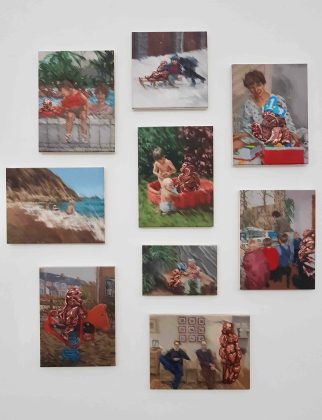
Smile
Ethical concerns in particular have been raised about the creation of organoids* made from human brain cells, as it may produce human-like consciousness existing in petri dish containers. Exploring this idea, “Smile” looks at the identity and subjective experiences of those lab-cultured mini-organs that are sourced from organs of human individuals. Paintings of family snapshots –inspired by Gerhard Richter’s photographic painting technique– depict organ-blob-like figures amongst people and environments, suggesting a personal history and kinship. Will organoids have the same childhood memories and family members as their human donor, or are these organoids nothing more than impersonal piles of cells, incapable of meaning-making? And to what extent is a memory factual or, in contrast, a construction?
*Organoids are organ cells sourced from human patients and grown in laboratories as self-organizing, 3D-structures that mimic the function of fully grown organs. Amongst a multitude of uses, organoids can be used for medicine development, or they could serve as living patches for diseased parts of mature organs. These microscopic tissues have a peculiar character; they are abstract yet multifunctional forms of life; they are protected from injury by glass and silicone surroundings; they are used to prevent disease and organ deterioration; but they are also idiosyncratic life forms that develop, could grow excessively, and will die; in other words, they have a unique form of existence and life cycle.
Dead animals with a backstory
A flock of sparrows tries to survive, chased from their home. Unable to migrate, they find refuge in posthumous identities.
Inspired by the 1958 “Eliminate Sparrows” campaign spearheaded by the Chinese Communist Party, a policy that tragically led to the Great Chinese Famine. Through this historical lens arising from archival material, the performance examines the instrumentalization of humans, drawing a stark parallel to today’s ecological crises and identity politics.


The real Brian Wilson
The Real Brian Wilson The Real Brian Wilson is a community-based project that examines how identity becomes unstable when tied to a shared name. Initiated in 2015 through an open call and online platform, the project invited individuals named Brian Wilson to contribute personal narratives, forming a distributed portrait authored by multiple, unrelated participants.
For this presentation, the work is structured as a one or two channel video that focuses on the tension between individual experience and collective identity. One channel follows a solitary Brian Wilson in Northern Ireland, moving through a landscape shaped by its own complex relationship to identity, while encountering fragments of a broader network of individuals who share his name. The second channel, when presented, introduces a gathering of Brian Wilsons in Scotland, where the name becomes a point of convergence rather than distinction.
Across both channels, the name “Brian Wilson” functions less as a marker of a singular person and more as a shared construct—circulating between individuals, locations, and narratives. The work positions identity as something that can be inhabited, repeated, and detached from authorship, allowing meaning to emerge through accumulation rather than singular origin.
The symphony of names: no man is an island
The Symphony of Names: No Man Is an Island is a single channel video work with stereo audio, composed from an original four channel installation and multi channel sound composition. The project examines how identity shifts when names no longer function as unique identifiers.
Drawing from Iceland’s naming system, where surnames do not operate as fixed markers of lineage, the work reconfigures names as shared and repeatable elements rather than singular identifiers. A young boy moves through the Icelandic landscape while a layered chorus of voices recites names drawn from the official registry. As the names accumulate, they form a structured but unstable sonic field, moving between legibility and abstraction.

Presented in this format, multiple perspectives are collapsed into a unified frame, reinforcing the idea that identity is not fixed or singular but distributed across language, repetition, and collective voice. Authorship becomes diffuse, and the name shifts from a marker of individuality to a system that exceeds any one person.


Aangenaam
As a transracial adoptee the subject of identity often arises. However, it is identity that is continually questioned from the outside before there is even time to reflect about it on the inside. Aangenaam exists out of two flow diagrams inspired by the infamous question “Where are you really from?”. The banners exist out of the many strange and uncomfortable, real life conversations the artist had with a multitude of people throughout her life. One takes place in the country where the artist grew up, and the other takes place in the country where the artist was born. Though, from a place of curiosity, these conversations often take strange turns and presumptions, and ultimately position the questioned person as the other.

Video performance
In the video performance 不会 the characters 我不会说中文 (wǒ bú huì shuō zhōng wén) are written repeatedly on a practice sheet for calligraphy. The characters are written with water and disappear over time. The sentence means “I cannot speak Chinese”. It was the first sentence learned by the artist in her mother tongue when returning to China, as a Chinese adoptee. The work and its repetition is as a mirror to the quantity of times the artist needed to explain herself. It reflects the frustration of constantly needing to expose one’s lack and position as the outsider, even in her birth country.
Human Layer
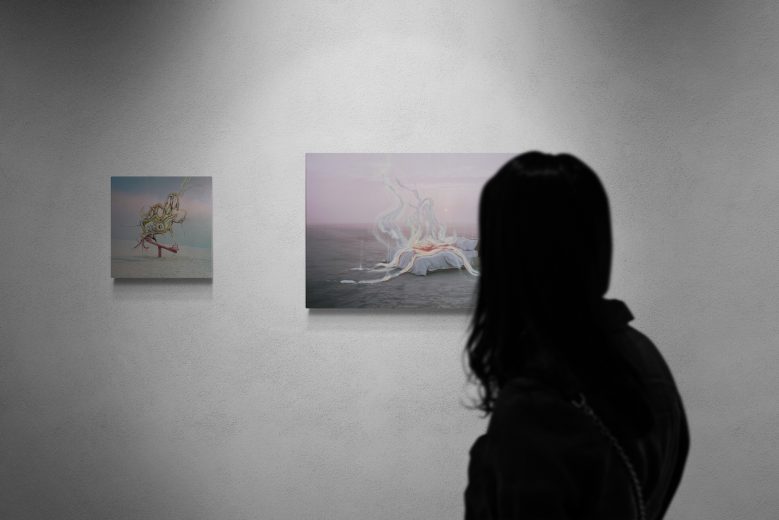
At the same time, Human Layer reflects a shift in how reality is perceived and replaced. The landscapes appear believable, but they are generated; they look like possible documents of the world, yet they are fictional. This uncertainty between the real and the synthetic creates a quiet, melancholic beauty.

[K-ODORANT]
A well-known Korean baseball player once revealed that after joining Major League Baseball in the United States, whenever he ate roasted garlic, he would eat large amounts of cheese to mask its smell.
The artist had a similar experience after moving to Europe, where garlic odor is often regarded as undesirable. In the artist’s home country, garlic is a staple ingredient used in almost every dish and holds deep cultural significance: according to Korea’s founding myth, the nation’s first ancestor became human after consuming garlic for 100 days. In an effort to adapt to Western society, the artist avoided eating garlic and tried to erase its smell.
The installation presents a launch display for a fictional product called K-ODORANT. While K-beauty has long been exported through images of refinement and cleanliness, garlic body odor, one of the most recognizable odors associated with Korean everyday life, has become something to conceal abroad.
Borrowing the language of K-beauty, K-ODORANT is both a brand and a declaration of a new product category. Although it takes the form of a conventional deodorant, it is conceived as a counter-object to the deodorant. Instead of eliminating body odor, it is designed to produce a garlic-scented body odor.
The work functions as a device that invites people to consciously choose an odor that has long been rejected. The artist questions whether rejecting garlic has become a self-imposed myth shaped by the internalization of social norms. Furthermore, the work explores how the invisible medium of odor can reconfigure the boundaries of human relations and reshape what is considered acceptable.